
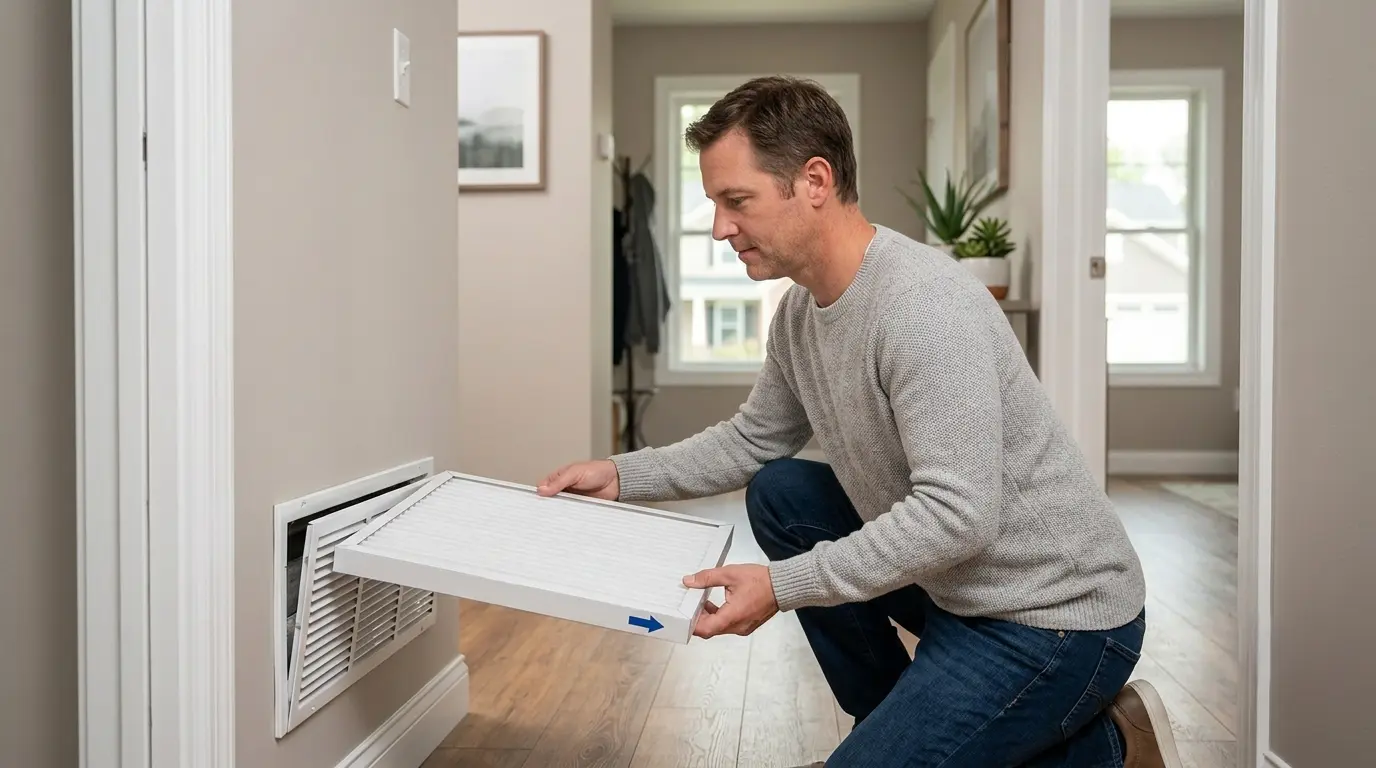
Ask any J&J technician the single best thing a homeowner can do for their HVAC system and the answer is unanimous: change the air filter. It’s cheap and easy, yet a forgotten filter is behind nearly half the emergency AC repair calls we run each summer in Battle Creek and Kalamazoo. So how often should you change your AC filter?
For standard 1- to 2-inch pleated filters in a typical home, inspect every 30 days and replace every 30 to 90 days. That range shifts with your home, though, and a few factors mean you’ll swap it more often.
Dogs and cats shed dander and fur that gets pulled straight into your return vents. Homes with multiple pets often need a fresh filter every 30 to 45 days, which also supports whole-home air purification for cleaner indoor air.
If someone has severe allergies or respiratory issues, upgrade to a higher-MERV filter and change it every 30 days to keep indoor air quality high.
During a July heatwave in Charlotte or Hastings, your AC runs almost nonstop, so the filter clogs faster. Pair filter changes with a seasonal summer AC maintenance tune-up.
Changing the filter is your job; deep-cleaning the internals is ours. A maintenance plan keeps your system running for decades. For over 50 years J&J has kept Southwest Michigan homes comfortable, so if the system still struggles after a filter change, schedule a visit or call (269) 965-1627.

MERV (Minimum Efficiency Reporting Value) measures how effectively a filter traps particles. While it might seem like a higher number is always better, ultra-high MERV filters (like MERV 13 and above) are extremely dense. If your HVAC system wasn’t specifically designed to handle them, they can severely restrict airflow, forcing your blower motor to work harder, raise your energy bills, and potentially cause the system to overheat or freeze. A MERV 8 to 11 filter successfully captures common household irritants, like dust mites, pollen, pet dander, and mold spores, without choking the essential airflow your system needs to operate safely.
You should only wash your filter if it is explicitly labeled as permanent; otherwise, you must completely change your AC filter with a brand-new replacement.
The vast majority of residential HVAC systems use standard, disposable pleated filters made of fiberglass or synthetic paper media. Attempting to wash these disposable models instead of performing a standard filter replacement will completely destroy the structural integrity of the filtering fibers. Furthermore, trapping moisture inside a disposable material creates a breeding ground for mold and bacteria. To keep your air clean and healthy, the best practice is to always fully change your AC filter with a fresh, dry replacement rather than trying to clean a temporary one.
The arrow printed on the edge of your filter frame must always point toward the furnace or air handler.
Air filters are engineered to trap dust in one specific direction. One side of the filter is structurally reinforced (often with a wire mesh) to prevent the force of the air from buckling or pulling the filter media into the fan. When installing a new filter, look for the printed arrow that indicates “Airflow Direction” and make sure it points away from the return air duct and directly toward the main HVAC unit where the blower motor is housed. Installing it backward reduces its filtration efficiency and can cause the filter to collapse under pressure.
Protect your system today: call J&J at (269) 965-1627 or schedule a visit.
Schedule service online or get in touch at (269) 965-1627 today!
9000 M-66 South • East Leroy, MI 49051
(269) 965-1627
Monday - Friday: 8:00am - 5:00pm
